
Battery Storage (BESS/SAEB) in the Dominican Republic: How the Regulatory and Tender Standard is Evolving in the Electricity Sector
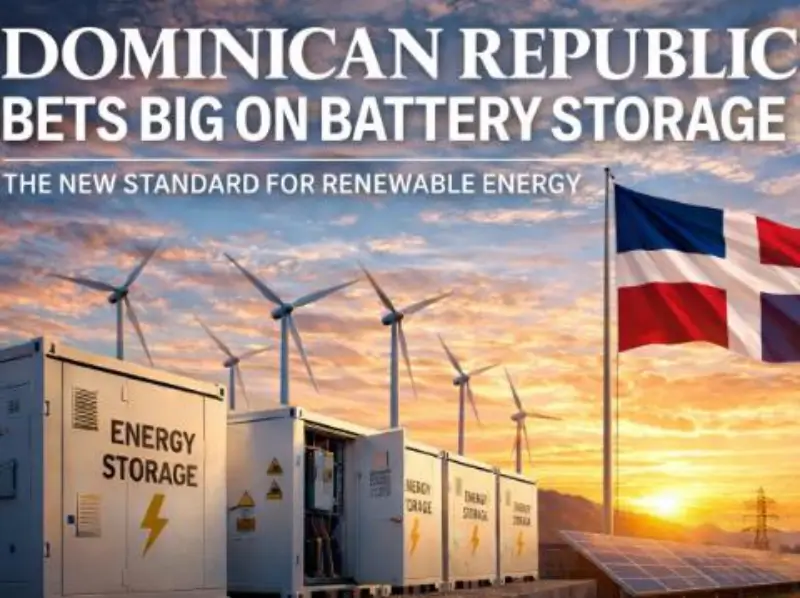
In the electricity sector, real transformations are not announced; they become evident in regulatory updates and in how the State procures energy. When an issue simultaneously appears in regulatory proceedings and public contracting processes, it ceases to be a technological hypothesis or a foreign novelty and becomes a practical benchmark for the market.
That is what is now being observed in the Dominican Republic with battery energy storage.
For variable renewable generation projects, particularly solar photovoltaic and wind, that integrate storage systems within the same technical solution, the Superintendencia de Electricidad established mandatory technical requirements applicable to that specific scenario through Resolution SIE-178-2025-MEM. In practice, this means that storage is not evaluated simply for being "installed," but for how it operates: its ability to meet the behavior required by the system and to demonstrate it with verifiable parameters.
The systems known internationally as BESS (Battery Energy Storage Systems), and referred to in local regulation as SAEB, are being expressly incorporated into certain relevant tracks of the electricity market, both from a regulatory perspective and from public procurement.
The Most Visible Signal: 600 MW Tender
The most visible signal comes from state contracting. The distribution companies EDENORTE, EDESUR, and EDEESTE, coordinated by the Consejo Unificado de las EDE (CUED), are carrying out tender EDES-LP-NGR-01-2025 to contract up to 600 MW of new solar and wind generation through long-term contracts. The distinctive element of the process is not just the volume, but the design: battery storage is part of the expected product in the competitive scheme.
Here lies the distinction that, in real life, determines whether a project moves forward or remains waiting.
The typical stumbling block is not buying "the wrong battery." It is believing that the project is the equipment. A project becomes investable when it closes completely: coherent permits, defensible connection, and contracts that turn performance into an enforceable obligation. Without that closure, you can have the best system in the world and still lose months.
Key Distinction: Hybrid vs. Standalone
It all starts with a simple question that determines the path, timeline, and costs: are you structuring it as hybrid or standalone?
If it's hybrid, storage is not "added" at the end. It is designed from day one to meet system behavior: ramp management, response to events, coordination with the renewable plant, and validation during commissioning. That is why EPC (engineering, procurement, and construction) and O&M (operations and maintenance) cannot be templates: they must tie down metrics, acceptance criteria based on performance, and contractual remedies if the system does not deliver what was committed.
If it's standalone, the center of gravity shifts. The critical asset is often the node and the strength of the record. A technically adequate storage system does not compensate for a weak interconnection or fragmented processing. In this track, delays are not measured in "inconveniences": they are measured in financial cost, lost opportunity, and commercial strain.
Conclusion: BESS is Already a Standard in System Expansion
The reasonable conclusion is not that storage is mandatory in all cases, but that it has ceased to be marginal in the tracks that are currently driving the expansion of the Dominican electricity system. In relevant public tenders and specific regulatory scenarios, BESS already operates as a technical and contractual standard.
Those who read this evolution in time will not gain a "technology" advantage. They will gain an execution advantage: designing projects that align with the real direction of the market and with what the regulator expects to see, both in the record and through testing.
About the author: Carlos Romero Polanco, Esq., an attorney specializing in litigation, public law, and economic regulation. Strategic advisor to companies in the public utilities, financial services, and investment sectors, as well as to government institutions and municipal governments in the Dominican Republic.