
The Man Who Built Everything and Couldn't Leave Anything
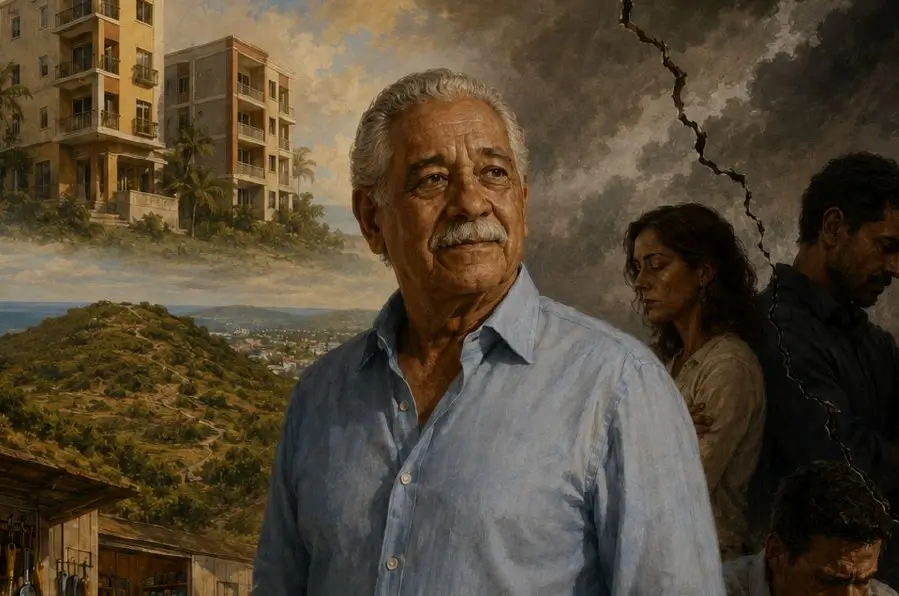
1 Don Rafael
Don Rafael built his world with his own hands. He started selling nails from a zinc stall and ended up owning a hardware store that didn't close even on storm days, three income-producing buildings, and some land up in the hills he bought when everyone laughed at him, because up there, they said, there was nothing but brush and wind.
He worked the way men who come from nothing work, with the certainty that stopping means dying. He raised three children under that roof. He gave them schooling, a surname, and an example. And every time someone talked to him about putting his affairs in order, signing a paper, thinking about the day he wouldn't be there, Don Rafael waved his hand, as if shooing away a mosquito, and always said the same thing: when I'm gone, let them divide it up; that's what brothers are for.
He died on a Tuesday. Without warning, while drinking coffee. He left no will, no donation, nothing signed, because talking about his death gave him a bad feeling and because someone, once, had told him that inheriting cost only three percent and that donating during one's lifetime was a luxury for wasteful rich people. Don Rafael, who counted every peso, chose not to spend on an afternoon at the notary's office. That was the most expensive decision of his life, and he wasn't even there to see it.
2 What remained after Tuesday
Today, four years later, his three children don't speak to each other. The eldest took over the hardware store and runs it as if it were his own, without accounting to anyone. The daughter wants to sell the buildings because she needs the money; the youngest refuses, out of pride or anger — no one knows anymore. To touch a single asset of the inheritance, all three signatures are needed, and all three signatures are at war. Lawyers charge for every filing in that war.
The hill Don Rafael bought for five, the one nobody wanted, is now worth forty. And when the children finally settled the estate, the three percent was not calculated on the five he paid: it was calculated on the forty of today, because the settlement is not based on what he originally paid, but on the fiscal or appraised value that serves as the basis at the time of declaration. They paid on the fortune inflated by time, not on the modest one their father knew.
But the money, however much, is the least of it. What was truly lost cannot be measured in pesos. What was lost was the family name. The name Don Rafael spent forty years building is crumbling in four years of litigation among the children he loved most.
And all of it, absolutely all of it, could have been avoided with one afternoon. A single afternoon at a notary's office, while he was still breathing and still in charge.
3 The doors he had open and never walked through
This is what almost no one explained to Don Rafael, and what very few know: Dominican law had prepared several doors for him to transfer his estate during his lifetime, with order, control, and peace. He died believing they were closed. They were open.
3.1 Usufruct reservation: handing over the shell and keeping the fruit
The first door answers the deepest fear of every man who has sweated for what he has: the fear of ending up with nothing for having given it away. It has a name and an article: usufruct reservation. Don Rafael didn't have to give away his buildings entirely. He could have donated only the bare ownership to his children while reserving the lifetime usufruct — a mechanism the Civil Code itself expressly recognizes in Article 918 when regulating transfers with usufruct reservation in the direct line. In plain terms: hand over the shell and keep the fruit. The building would appear in the children's names on the title, but the rents would continue falling into his pocket until the last day of his life. He would not have lost a peso of income, he would not have lost his roof, and yet the asset would have been arranged during his lifetime, far from the chaos of an improvised succession. The man who fears being left with nothing is not left with nothing: he releases ownership and retains enjoyment.
3.2 Law 30-26: donating during your lifetime no longer costs more than inheriting
The second door had just swung wide open right when he needed it, and he never found out. Throughout Don Rafael's life, donating during one's lifetime cost twenty-seven percent, while inheriting cost three. That ninefold difference was what had convinced him to wait for death.
But Article 57 of Law 30-26, enacted on June 18, 2026, equalized the donation tax rate to the succession tax rate, and that rate, set by Article 6 of Law 2569-50 as amended by Law 288-04, is just three percent. Overnight, donating ceased to be a luxury for the wasteful and became taxed at the same primary rate as inheriting. The reason Don Rafael had to wait evaporated. Only he was no longer around to find out, and his children continue paying the price of a belief the law had rendered false.
3.3 Conditions and revocation: protecting the donation without losing control
The third door answers another legitimate fear: that of giving something away only to have the child respond with ingratitude. The Civil Code also has an answer for that. Article 953 allows revoking a donation for ingratitude when the donee has attempted against the donor's life, has been guilty of serious insults, or denies support. However, with an unforgiving clock worth knowing: Article 957 requires filing suit within one year of becoming aware of the fact. The donation was not a surrender; it was an act that could be safeguarded with conditions and undone in the face of betrayal.
3.4 The forced share: the limit no one can exceed
There was, however, a limit that neither Don Rafael nor anyone can exceed, and it is precisely the one that causes the most errors among those who improvise without a lawyer. The law reserves an untouchable portion for the children: the forced share (legítima). Article 913 of the Civil Code establishes that donations may not exceed half of the assets if one child is left, one-third if two are left, and one-fourth if three or more are left.
With his three children, Don Rafael could only freely dispose of one-fourth. If he had donated to one above his available portion, the others, upon his death, could have sought the reduction of that donation, and what was given to one child would have been presumed an advance on his inheritance unless expressly made with a waiver of collation. That is why planning is not giving blindly: it is designing within the limits the law imposes, so that the gesture of favoring one does not later become the war of all.
4 The estate planning trust
And for an estate like his, with a living business and multiple properties, there was the greatest door of all, the one that governs from beyond the grave: the estate planning trust under Article 55 of Law 189-11.
Don Rafael could have transferred the hardware store and the buildings to a professional trustee, with precise instructions left by authentic act, so that his children would receive income without being able to fragment the business, so that the eldest couldn't take over the cash register, so that the daughter couldn't auction off the buildings at the first hardship.
Law 189-11 itself acknowledges that this design does not violate the forced share as long as each heir receives their corresponding proportion. The transfer of assets to the trust is also exempt from income tax and capital gains tax, and the assets remain segregated in a trust estate, protected against subsequent creditors under the terms of the law and barring fraud.
The trust would not have erased the final three percent succession tax, which is still paid upon the settlor's death, but it would have done something money cannot buy: keep the business whole and the family united.
5 The same man, two legacies
Let us imagine the other Don Rafael. The one who, one afternoon, instead of waving away the mosquito, sat down with a lawyer. The one who donated the bare ownership of his buildings to his three children while reserving the usufruct, and continued collecting every rent until the end. The one who placed the hardware store in a trust so that no child could tear it apart. The one who distributed the hill with a waiver of collation, within his available portion, without harming anyone.
That Don Rafael also died on a Tuesday. But he died knowing. Knowing that his name would remain held high, that his business would continue opening on stormy days, that his three children would sit together at the same table as always without a lawyer between them.
The same estate. Two opposite destinies. And between one and the other, a single decision that cost one afternoon.
6 You are still breathing
The difference between the two Don Rafaels is that one waited and the other acted. If you have built something, whatever it may be — a house, a business, a piece of land that grows more valuable each year — you are today exactly where that man was before the Tuesday. With the doors open. With time still on your side. With the lowest rate that has existed in decades, freshly placed on the table by the law.
At LegalHub RD, we design the transfer of your estate during your lifetime with usufruct reservation so you do not lose your income or your home, with conditions that protect what you give, with the trust that keeps united what took you a lifetime to build, and with the file that withstands any audit. We do it while you are still in charge, which is the only time it can be done.
But doors do not remain open forever, and Tuesday never gives notice.
Write to us directly at contact@legalhubrd.com or call us at 1-809-886-7071. We review your case free of charge to diagnose the best roadmap and the appropriate estate plan for your assets in the Dominican Republic.
7 Legal notice
The cited provisions come from verified primary sources: Articles 913, 918, 953, 955, and 957 of the Dominican Civil Code; Article 57 of Law 30-26 (enacted June 18, 2026); Article 6 of Law 2569-50 as amended by Law 288-04, ratified by the DGII; and Articles 9, 46, and 55 of Law 189-11. The specific application to each estate — number of heirs, nature of the assets, marital regime — must be analyzed on a case-by-case basis before executing any transaction.