
In the AI Era, Your Image Can Become a Business or Cost You Your Reputation
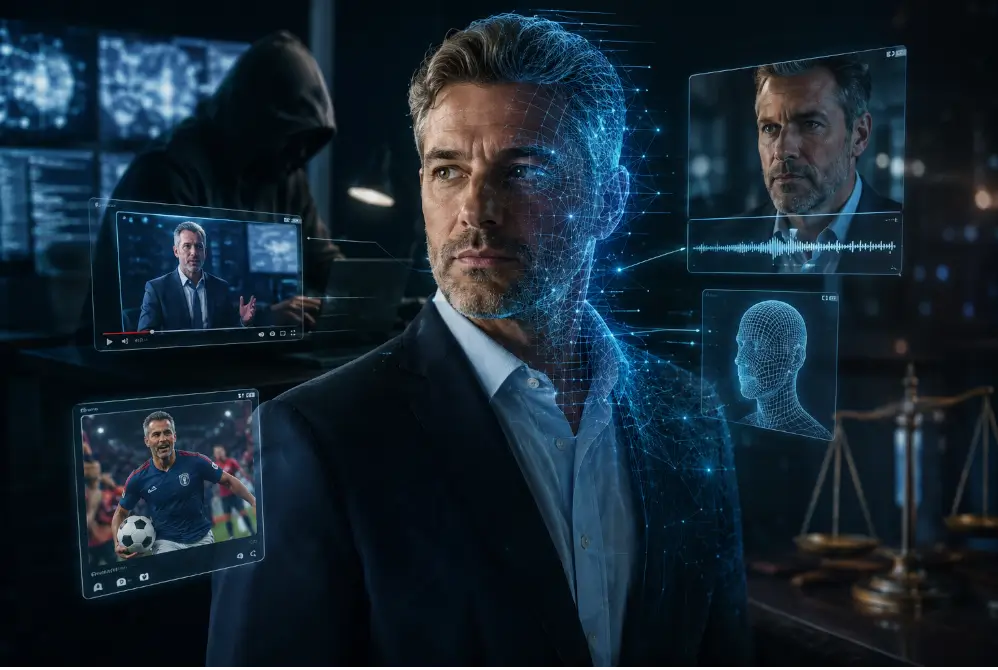
Deepfakes, cloned voice, assignment of digital rights, and AI replicas: what public figures, athletes, artists, influencers, and entrepreneurs must structure before a third party monetizes their image or, worse yet, destroys it.
In the Dominican Republic, WhatsApp, social media, and paid YouTube ads are already circulating videos generated with artificial intelligence that portray government officials, well-known entrepreneurs, and media figures recommending investment platforms they never approved — a pattern that has already alerted Dominican authorities. The video looks real. The voice sounds identical. The face moves naturally. Thousands see it. Some unsuspecting people invest.
The person depicted never recorded or consented to anything.
George Carlin filed a lawsuit over an AI-generated special that imitated his style; the content was removed and the estate obtained a written commitment not to use his likeness. In video games, cases like Keller v. Electronic Arts and No Doubt v. Activision established that exploiting the likeness of real people under the guise of entertainment does not escape liability.
What once required a production studio can now be done by anyone with access to a basic AI tool.
THE RISK IS NOT THE SAME FOR EVERYONE. FOR SOME, IT IS EXISTENTIAL.
This is not science fiction. It is the present. And the damage does not end when the video disappears: it ends when reputation is restored, those responsible are identified, and losses are recovered. The question is no longer whether your image has value. The question is who is exploiting it, under what authorization, and who is getting paid for it.
THE MOST DANGEROUS MISTAKE: BELIEVING THAT IF IT'S NOT REGISTERED, IT CAN'T BE PROTECTED.
No one can go to the copyright office and register their face. Copyright protects works: songs, photographs, films, texts, software. It does not protect a person's identity, their natural voice, their face, or their fame. But that does not mean the image is unprotected. It means protection does not come from a single registration or action: it comes from structuring identity as an asset through contracts, trademarks, tort law, and control over unauthorized commercial use.
When the Dominick's supermarket chain used Michael Jordan's name and his number 23 in a commercial advertisement congratulating him on his Hall of Fame induction, without asking permission or offering him a dollar, Jordan sued. The jury awarded him $8.9 million. Not because he had copyright over his name. But because no one may use another person's identity to generate commercial value without authorization. That is the rule. With artificial intelligence, the risk escalates.
THE CASES THAT CHANGED THE RULES.
In January 2024, sexually explicit images generated with AI of Taylor Swift went viral on X with over 45 million views in less than 17 hours. The case reached the White House and contributed to the passage of the Take It Down Act, signed into law in May 2025, which requires platforms to remove non-consensual intimate images within 48 hours. That same year, OpenAI released a ChatGPT voice called Sky that Scarlett Johansson described as "eerily similar" to her own: the actress had rejected Sam Altman's offer to license her voice, hired lawyers, sent them two formal letters, and OpenAI removed the voice.
For a soccer player like Cristiano Ronaldo, a basketball player like LeBron James, a golfer like Tiger Woods, or a baseball player like Shohei Ohtani, Image Rights is a separate contract from their athletic salary, managed by their own companies and licensing structures that are worth as much as or more than the contract with the club. For a singer, their voice can be as valuable as their catalog. For an actor, their face can generate income long after their last role. For an influencer, credibility is the business.
For a Politically Exposed Person, the risk has an additional dimension. A deepfake that falsely associates them with a financial scheme not only damages their reputation: it can compromise their regulatory compliance profile, trigger alerts in due diligence processes, and activate consequences under anti-money laundering frameworks. Law 155-17 places PEPs in a higher-scrutiny category. A fake video linking them to financial movements is a risk that goes far beyond personal harm.
For the heirs of any recognized figure: a legacy without contractual structure is an unprotected asset, exploitable after death.
BUT THIS IS ALSO A BUSINESS. IF YOU STRUCTURE IT.
Artificial intelligence not only provides technical tools to exploit an image without authorization. It also allows the rights holder to monetize it in ways that were previously impossible. The Swedish group ABBA turned digital replicas of themselves into a global show. James Earl Jones authorized the technological use of his voice to preserve Darth Vader. KISS transferred catalog, brand, name, image, and likeness to Pophouse. SAG-AFTRA already negotiates compensation, consent, and usage reports for digital replicas of actors and performers.
In January 2026, Khaby Lame, the most followed comedic content creator on TikTok with 160 million followers, closed a deal valued at $975 million, structured through a stock issuance, which includes exclusive rights to his brand, image, voice, and the development of an AI Digital Twin to generate content in multiple languages. Digital identity already has a price, a market, and a contractual structure. In the AI era, you can be sleeping while your digital version works. The question is whether it works for you.
THE DIGITAL ASSIGNMENT: THE CONTRACT THAT MOST DON'T HAVE.
The famous Netflix series Black Mirror made it a popular image with "Joan Is Awful": two women trapped by contracts they didn't understand or misjudged. Fiction exaggerates to unsettle. Contractual risk, perhaps not so much. Image protection in the AI era is not improvised in a generic clause. The contract must expressly define what is authorized: use of face, voice, body, gestures, style, avatar, facial scanning, synthetic dubbing, deepfake, digital replica, AI model training, video games, series, films, advertising, post-mortem use, and sublicensing to third parties.
The phrase "use of image by any present or future means" which for years seemed sufficient may today mean too much or protect nothing. Signing poorly is cheaper today. Fixing it tomorrow may cost everything.
IN THE DOMINICAN REPUBLIC, THERE IS PROTECTION. BUT YOU MUST ACTIVATE IT.
Article 44 of the Constitution protects honor, good name, and self-image. Law 65-00 protects the related rights of artists, performers, and executors (Art. 135). Laws 42-08 and 20-00 regulate unfair competition, including acts of deception, confusion, and improper exploitation of reputation. Law 358-05 may be triggered if the deepfake induces a consumer to buy or invest. Law 53-07 applies to fraud, identity theft, defamation, or libel through electronic means. Article 110 of Law 834 allows the injunctive judge to order urgent measures to stop imminent harm.
Before the damage: contracts. After the damage: litigation. LegalHub RD works with public figures, athletes, artists, influencers, entrepreneurs, agencies, and families throughout the digital identity lifecycle: auditing and structuring image contracts, assignment and licensing of digital rights, voice and likeness protection, AI replicas, unfair competition, urgent measures against platforms, and indemnity claims.
Contact: info@legalhubrd.com | www.legalhubrd.com for more articles of interest.