
Spanish Investment in the Dominican Republic: Structure, Incentives and Returns
1 Introduction
The Dominican Republic is not a foreign market to Spain. The relationship spans centuries. Santo Domingo was the First City of the Americas and one of the first spaces where Spain projected language, law, commerce, and institutions onto the continent. That history left permanent legal, cultural, and economic ties that still facilitate business dialogue between both countries.
Spain knows the Dominican Republic through tourism, construction, banking, energy, services, industry, and infrastructure. And the Dominican Republic knows the Spanish way of doing business: hotel groups, operators, contractors, banks, energy companies, suppliers, consultants, and family businesses.
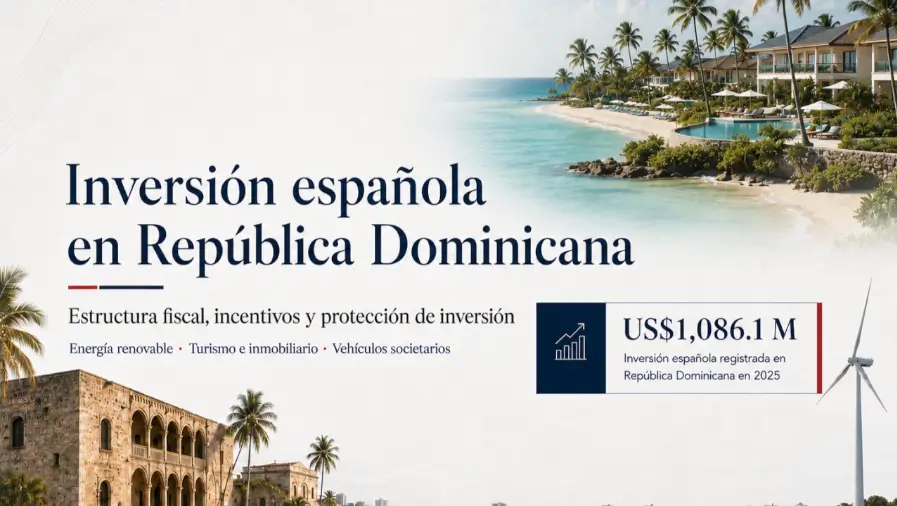
Today, this relationship is entering a different stage. It is no longer just about historical presence or cultural affinity. It is about Spanish capital participating in sectors where the Dominican Republic maintains growth, demand, and need for investment. In 2025, registered Spanish investment in the Dominican Republic reached approximately US$1,086.1 million. Spain remains among the top foreign investors in the country.
For a Spanish investor, the Dominican Republic should not be seen solely as a tourism destination. It should be seen as an investment platform in renewable energy, tourism, real estate, free trade zones, logistics, services, infrastructure, and companies with public contracts, permits, or concessions.
Returns do not depend solely on buying or investing in a good asset. They depend on how you enter. The corporate vehicle, the applicable incentive regime, financing, taxes, permits, contracts, capital repatriation, investment protection, and exit strategy can change the economic outcome of the same transaction. Two investors can look at the same Dominican market and end up with very different returns. The difference usually lies in the structure.
2 Renewable Energy
Renewable energy is one of the most relevant sectors for Spanish capital in the Dominican Republic. The country needs generation, stability, investment, technology, and financing. Spain has companies, experience, and capital in solar, wind, operations, engineering, equipment, and project finance.
Law 57-07 on Incentives for the Development of Renewable Energy Sources and their Special Regimes provides incentives for renewable energy projects, provided the project qualifies and obtains the corresponding approvals.
One of the clearest benefits relates to external financing. Simply put: if a Dominican project is financed with external debt, the interest paid to the foreign lender is normally subject to a 10% withholding tax. If the renewable project qualifies under Law 57-07, that withholding can be reduced to 5%. This is not a discount on the entire investment. It is a reduction on the interest on external debt. But in large, long-term financed projects, that difference can improve the effective cost of capital, the project's bankability, and the investor's net return.
In addition, the renewable energy promotion regime may include incentives on the importation of equipment, parts, machinery, materials, and components necessary for renewable energy systems, as well as applicable ITBIS treatment and other benefits provided by the regulations.
However, to access these benefits, one must verify technology, eligible equipment, CNE approval, permits, contracts, financing, imports, and documentary support. In energy, a poor structure can affect available cash flow, debt, permits, and bankability. A good structure can improve returns from financial close onward.
3 Tourism and Tourism Real Estate
Tourism has been one of the great bridges between Spain and the Dominican Republic. Punta Cana, Cap Cana, Bávaro, Bayahíbe, La Romana, Samaná, Las Terrenas, Miches, Río San Juan, and Pedernales form part of a map where Spanish capital understands the business: hotels, villas, branded residences, short-term rentals, mixed-use projects, and tourism assets with operational potential.
Here, an important advantage emerges: CONFOTUR. The Tourism Development Council is the body that administers the incentive regime under Law 158-01 for approved tourism projects. When a project qualifies, it may receive significant tax benefits, including exemptions from Income Tax linked to the project, real estate transfer tax, IPI, ITBIS, and import duties on materials, equipment, and goods necessary for construction, equipping, and operation, within the approved scope.
This directly impacts returns. A project with correctly applied exemptions can reduce tax costs at entry, construction, and operation stages, improve available cash flow for the investor, and strengthen its position at the time of sale.
But the benefit does not depend on the beach or the commercial brand. It depends on the approved resolution. One must review which project was approved, which phase it covers, which unit is included, who the beneficiary is, what the term is, what economic use is permitted, whether the benefit can be transferred, and what conditions must be maintained. Two assets in the same tourism hub can have different tax treatments. In tourism, those who review the file late may discover late that they bought less benefit than they thought.
4 Foreign Investment, Dividends, and Repatriation
The Dominican Republic has a favorable legal framework for foreign investment. Law 16-95 on Foreign Investment allows the foreign investor to remit abroad the invested capital and declared dividends, in freely convertible currency, without prior authorization, once the corresponding tax obligations have been fulfilled.
This is important for the Spanish investor: capital can enter, operate, generate profits, and exit, provided the investment is registered, the accounting is clear, dividends are formally declared, and the corresponding taxes have been paid.
Regarding taxation, dividends are subject to specific treatment. The Dominican rule provides for a 10% withholding on dividends paid or credited, applicable to residents and non-residents. This rule is distinct from the general regime for outward remittances.
Therefore, dividend repatriation should not be analyzed as a simple international transfer. It must be reviewed as a corporate distribution: available profits, corporate resolution, applicable withholding, accounting support, beneficial owner, application of the Spain–Dominican Republic Tax Treaty, and tax treatment in Spain.
When the structure meets the Treaty requirements, the result can improve further. In particular, if a Spanish company directly holds at least 75% of the capital of the Dominican company paying the dividends, and the other treaty conditions are met, the Dominican-source withholding can be eliminated. This does not mean zero total taxation. The tax treatment in Spain must be analyzed separately. But it can improve available cash flow for the investor and make profit distribution more efficient.
5 Spain–Dominican Republic Tax Treaty and Exit
The Double Taxation Treaty between Spain and the Dominican Republic can affect dividends, interest, services, royalties, and capital gains.
But the Treaty does not apply automatically. It is not enough to place a Spanish company in the organizational chart. One must review tax residence, beneficial ownership, economic substance, documentation, and coherence between the legal structure and the actual operation.
The exit must also be considered from the entry point. If the value of a Dominican company derives mainly from real estate located in the Dominican Republic, the gain from the sale of shares may be taxable in the country. This matters in hotels, land, villas, tourism developments, real estate companies, and holding vehicles. Buying well is not just about negotiating price. It is about knowing how you will collect, distribute, and sell.
6 Reciprocal Investment Protection
Spain and the Dominican Republic have a Reciprocal Investment Protection Agreement (APRI). This instrument does not freeze taxes, eliminate regulatory risk, or turn any administrative dispute into an international claim. Its value lies elsewhere: it provides an additional layer of protection when a properly structured and documented investment faces a discriminatory, unjustified, expropriatory, or otherwise contrary state measure against the guarantees recognized to the investor.
In certain scenarios, and in accordance with the treaty's own conditions, an investor-state dispute may be submitted to international arbitration. The arbitral route provided in the treaty functions as a protection mechanism against certain state risks. In transactions linked to contracts, concessions, permits, authorizations, resolutions, corporate holdings, or property rights vis-à-vis the State, that protection can strengthen the investor's legal position if the investment was properly structured and documented from the entry stage.
7 Companies with Public Contracts, Permits, or State Relationships
There are also opportunities in Dominican companies with public contracts, concessions, permits, authorizations, or state-linked payments. In these cases, the analysis cannot be limited to revenues, EBITDA, or projections. The legal basis of the cash flow must be reviewed: current contracts, bidding documents, guarantees, payment history, contractual amendments, economic equilibrium, termination risks, regulatory compliance, permits, and administrative disputes.
A company can show attractive numbers and, at the same time, carry high legal risk if its contracts or permits are not well supported. In this type of transaction, part of the price lies in the quality of the file.
8 Conclusions
The Dominican Republic offers a real opportunity for Spanish capital. Renewable energy, tourism, real estate, free trade zones, logistics, services, infrastructure, companies with public contracts, and corporate vehicles.
But returns are not protected merely by finding a good asset. They are protected by entering properly.
Before committing capital, it is advisable to review:
- How foreign investment is registered;
- How capital and dividends will be repatriated;
- Whether Law 57-07 applies;
- Whether CONFOTUR applies;
- Which corporate vehicle is suitable;
- Which withholdings apply;
- Whether the Spain–Dominican Republic Tax Treaty improves cash flow;
- Which permits and contracts support the asset;
- Whether investment protection exists and arbitration is possible;
- How the investment will be sold or exited.
In cross-border investment, the structure is not corrected at the end. It must be clear before committing capital, because afterwards any adjustment usually costs more: in taxes, permits, financing, available cash flow, or exit price.
At LegalHub RD, we approach the local structuring of Spain–Dominican Republic investments from that perspective: entry taxation, incentives, financing, repatriation, permits, contracts, documentation before authorities, investment protection, and exit strategy.