
The New Criminal Exposure of Government Contractors
An analysis for every company (and its representatives) that operates, bids, or contracts with the Dominican State.
By Carlos Romero Polanco · Economic Criminal Law · Corporate Compliance · Public Procurement
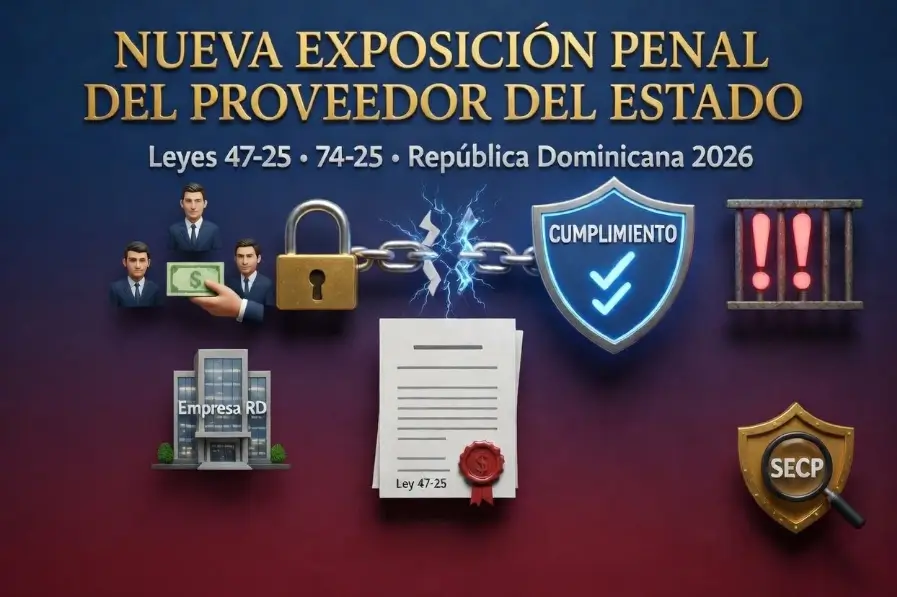
Companies that operate or contract with the Dominican State currently face two parallel risk systems. The first is already active: Law 47-25 on Public Procurement came into force on January 28, 2026, with its own criminal provisions that criminalize bribery, collusion, and fraud in public procurement and include criminal liability for legal entities. The second arrives in August 2026: Law 74-25, the new Penal Code, establishes a general regime of corporate criminal liability and incorporates criminal offenses that directly affect private individuals in their relationship with the State. These are two different laws, with different effective dates and different rules. Treating them as one is the first mistake a businessperson cannot afford to make.
I. What is in force today: Law 47-25
Since January 28, 2026, every company participating in public procurement operates under a regime where bribery, collusion, and fraud have direct criminal consequences. Decree 52-26, the implementing regulation issued the same day, reinforces this system with a traceability architecture in the Electronic Public Procurement System (SECP) designed to detect patterns of irregular behavior. The General Directorate of Public Procurement (DGCP) has full authority to investigate, annul awards, suspend the State Supplier Registry, and refer findings to the Public Prosecutor's Office.
What has changed is not just the severity of the penalties. The logic of the system has changed: the State no longer needs to catch anyone red‑handed. It needs the SECP data to add up. When they don't, the investigation begins on its own.
Bribery of a public official: 4 to 10 years imprisonment and a fine of one hundred (100) to two hundred (200) minimum wages in the public sector.
Corruption or collusion among bidders/officials: 2 to 5 years imprisonment and a fine of 20 to 50 minimum wages in the public sector.
Legal entity: Fine of 500 to 5,000 minimum wages in the public sector and definitive closure by final judgment, regardless of liability for acts committed by its owners, controllers, responsible parties, principal executives, representatives, or those performing administration and supervision activities.
Law 47-25 eliminated the former ten percent threshold for absolute incompatibilities. Any direct or indirect shareholding triggers the disqualification. This omission should no longer be read only as a documentary problem: the law itself criminalizes falsehood in sworn statements required to register as a State supplier or to participate in a procedure, even if there is no award. The SECP can cross-check that statement with commercial registers in hours.
II. Three behaviors that the SECP already detects
1. Disqualified company concealing a corporate link
A company disqualified due to a corporate link with an official of the contracting entity activates a different corporate name and submits a sworn statement that does not disclose that relationship. It would be a business error to read this criminal block as if it were limited to bribes or collusive agreements. Law 47-25 also penalizes the willful violation of the disqualifications and prohibitions regime, undue interest in the execution of contracts, and provides for criminal liability of the legal entity when the offense is committed for its interest or benefit by persons with management, representation, administration, or supervision functions, as a result of failures in its control duties. Simply put: the risk does not only reach the direct perpetrator of the maneuver; it may also reach the benefited company when the act was made possible by a weak, permissive, or deliberately blind internal structure.
2. Unjustified payments to connected advisors
A company obtains a major award. Two weeks later it pays for strategic advice to a firm linked to someone who intervened in the evaluation process. No verifiable deliverables, no prior contract, an amount equivalent to a percentage of the awarded value. The flow is recorded. Under Law 47-25, this is not just classic bribery: the offer, promise, commission, gift, or advantage proposed to an official to obtain a favorable act in the procedure has its own criminal treatment. The manager who authorized it and the financial officer who processed it are potential active subjects. The shareholder who received the net flow at the end of the chain does not need to have signed anything to be exposed.
3. Patterns of alternation in awards
Three companies that alternate awards. The pattern can be seen in the SECP: in six consecutive processes of the same institution, the three companies always appear together, rotating the winning position. But the risk is not limited to horizontal collusion among bidders. Law 47-25 also punishes prohibited agreements between officials and private parties to fix technical or economic conditions of the tender documents with the aim of favoring a bidder. In other words: rigging can start before the bid. The companies involved and their directors are in the criminal zone even if no compromising audio ever appears.
III. What is coming in August: Law 74-25
Law 74-25, the new Dominican Penal Code, was enacted on August 3, 2025, and enters into force twelve months later, in August 2026. It is not in force today. Its provisions do not yet apply. But every company that operates or contracts with the State must prepare for that moment because it irreversibly changes the architecture of criminal liability.
Article 8 establishes that legal entities are criminally liable for acts or omissions of their bodies, representatives, or subordinates when the act is committed on their behalf and is explained by failures in direction, supervision, or control. Article 9 specifies that this liability does not exclude that of the natural person who is the perpetrator or accomplice. Article 10 makes it survive even after the dissolution of the company. Article 11 extends it to the controlling company.
The practical result is precise: the shareholder who designed the structure without signing anything, the manager who approved the payment without asking, and the financial officer who processed it without objecting are not saved by having operated behind a corporate seal. And the company that dissolves after the facts does not extinguish its criminal liability either.
Art. 8 – Liability of the legal entity: It is criminally liable for acts or omissions of its bodies, representatives, or subordinates when the act is committed on its behalf and is explained by failures in direction, supervision, or control.
Art. 9 – Shared liability: The liability of the company does not exclude that of the natural person who is the perpetrator or accomplice.
Art. 10 – Survival: Criminal liability survives even after the dissolution of the company or any corporate restructuring.
Art. 11 – Extension: Liability extends to the controlling company when it maintains legal or de facto control over the one that committed the offense.
Art. 291 – Active bribery: Whoever proposes to a public official, directly or indirectly, offers, promises, gifts, or advantages to obtain that the official perform or refrain from an act within their functions. Active subject: the private individual. Penalty: 4 to 10 years of major imprisonment.
Art. 290, paragraph – Contract without legal requirements: The private individual who enters into a contract with the administration knowing that it does not meet the essential legal requirements for its processing, execution, or settlement. Penalty: 5 to 10 years of major imprisonment.
Art. 294 – Passive influence peddling: Whoever, taking advantage of their personal relationship with a public official, influences them to obtain a decision that generates an economic benefit, or offers to do so in exchange for remuneration. It does not require being an official. Penalty: 5 to 10 years of major imprisonment.
The company excludes its criminal liability when it objectively demonstrates that it had adopted compliance programs that were evaded through fraudulent maneuvers, and that management reported them to the competent authority.
Minimum requirements for the program (art. 8, Para. IV): identification of areas of criminal risk, autonomous supervisory body, protocol for action in the face of detected risks, internal disciplinary system, and periodic review.
IV. What a company must implement today
- Compliance program with an autonomous body. Art. 8, Para. III of the new Penal Code turns this program into the only mechanism the law recognizes as a defense. It must exist before the act, with identification of criminal risks, reporting channel, disciplinary system, and periodic review. In public procurement it must cover sworn statements, disqualifications, tender documents, conflict of interest, third parties, commissions, and payment traceability. Before August 2026.
- Mapping of ultimate beneficial owner. Law 47-25 eliminated compatibility thresholds. Any corporate link with an official triggers disqualification. Opacity can be the origin of the offense.
- Review of sworn statements. With criminal logic before approaching the State. An inaccuracy that the SECP can cross-check can become a standalone offense even if the company is not awarded the contract.
- Third-party and payment policy. No payment to a manager, advisor, or agent without documented economic cause, prior contract, and real deliverables. The flow that cannot be explained is the piece that connects the money to the offense.
- Conflicts of interest. Written policy, mandatory disclosure, documented abstention, and reinforced review. Under Law 47-25, undue interest and willful violation of the disqualifications regime have direct criminal implications.
Under Law 47-25 the risk is already real and already active. And it is broader than many believe: it is not limited to bribery or collusion, but extends to false sworn statements, participation while disqualified, circumvention through third parties, undue interest, and rigging of tender documents. Under Law 74-25 the risk becomes even more serious in August 2026, because the failure of direction and supervision becomes the gateway to corporate criminal liability. The company that confuses the two laws, or that reaches August without a verifiable compliance program, arrives without the only defense the law recognizes as sufficient.
And that question will be answered by the case file.